How a swarm moves
Testing how individual decisions give rise to collective motion in locusts.
Explore project
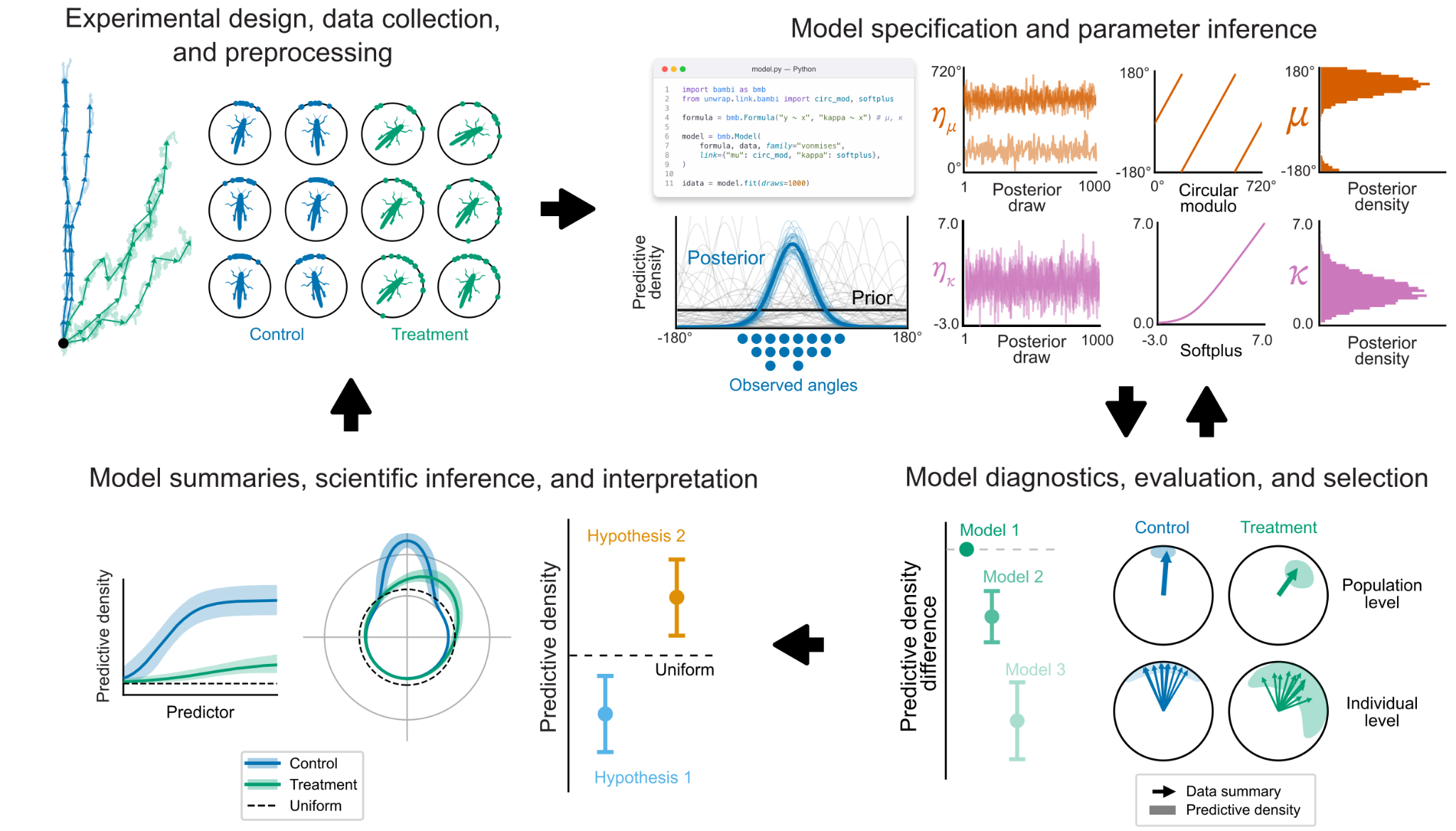
This study revealed that locust swarming behavior emerges from internal decision-making processes rather than alignment with nearby individuals. I collaborated with colleagues to analyze behavioral data from controlled lab and immersive virtual reality experiments, developing a Bayesian model to test competing mechanistic hypotheses of collective motion. Our results challenged classical alignment-based theories, showing that group coordination emerges from individual decision-making informed by neural representations of neighboring locusts.
Links
Publication · Perspective · Feature Article · Model Code
Citation
Sayin, S., Couzin-Fuchs, E., Petelski, I., Günzel, Y., Salahshour, M., Lee, C.-Y., Graving, J.M., Li, L., Deussen, O., Couzin, I.D., et al. (2025). The behavioral mechanisms governing collective motion in swarming locusts. Science, 387(6737), 995–1000. https://doi.org/10.1126/science.adq7832